Most of the seals we replace aren't worn out. They're painted over, or they're gone and the groove is empty.
What we find
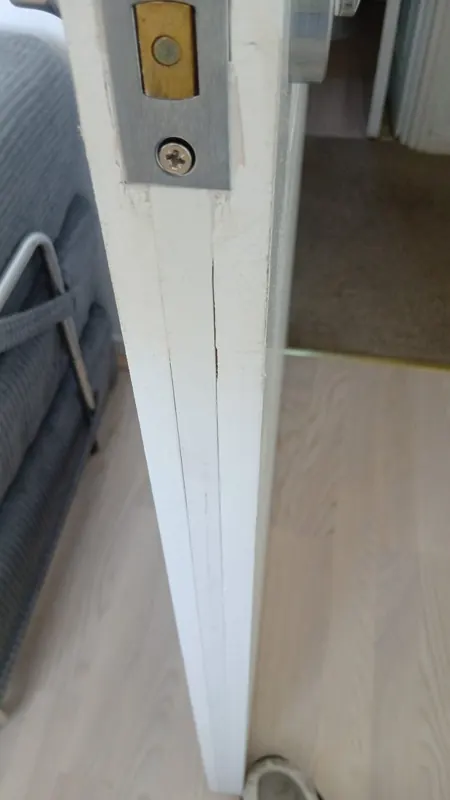
Paint comes first. Somebody redecorated the landing and the brush went straight over the seal. Then there are strips pulled out because they looked like draught excluder, and doors planed to make them shut, which took the seal off with the shaving. Split edges turn up too, like the one in the photo, and a seal in an edge like that has nothing left to sit in.
On the day
Out comes whatever's left of the old strip, usually with a knife and some patience, and the groove gets a good clean. The new one has to match the door. If the edge has a label or a plug we go by that, and if it hasn't, we copy what was fitted and write it down. Double doors get the middle edge done as well, because everyone forgets it.
Then we shut the door and watch it latch. Fresh seals push back harder than tired ones, so a closer that was coping may suddenly stop short. A quick turn on the valve sorts it before we leave.
Flats
We've sealed the doors in a block of flats in Stevenage. Smoke gets out of a flat through the gaps round its door, and it's the first thing the neighbours in the corridor meet. When the seals sit in the frame the door stays on its hinges, so nobody is locked out while we work.
A painted seal usually comes with painted hinges. We look at those and the label while we're there, since two faults found on one visit is cheaper than coming back.
Questions we get asked
Can the decorator paint round the seals?
Yes, if they mask them first.
The door's harder to shut since the new seals. Is that wrong?
No. The seal pushes back, which is its job. A quarter turn on the closer fixes it.
Send the list and the postcode. We will come back with a fixed price for each door.
Get a price